
Evaluating the Red Sox Deadline
I needed some time to process what the Red Sox did at yesterday's trade deadline.

To say the Red Sox had an eventful trade deadline would be an understatement. One thing is certain: nobody can accuse Craig Breslow of being timid. Breslow was active throughout the day, making several bold decisions that will shape both the present and future of the organization.
In total, the Red Sox completed three trades. They added three players to the major league roster, parted with one major leaguer, and traded away five prospects—including Marcelo Mayer—along with a player to be named later.
There are several ways to evaluate Boston’s trade deadline, and each tells a slightly different story.
The Trades
Adley Rutschman and Jake Rogers for Anthony Eyanson (#2), Kyson Witherspoon (#3), Enddy Azocar (#6), Carlos Narváez, PTBNL
Erik Miller for Marcelo Mayer
Eli White for Tyler Uberstein
The first way to evaluate these moves is through the lens of the 2026 season. If you ask whether the Red Sox are a better team today because of these trades, I think the answer is undoubtedly yes. Boston acquired one of the best catchers in baseball and an elite left-handed reliever to strengthen what was already the No. 1 bullpen in the majors.
The cost of acquiring a player like Adley Rutschman—who is under team control through the 2027 season—was always going to be significant. I think the general consensus is that the price ended up being steeper than many expected, as Boston had to part with its top two pitching prospects and another prospect ranked in the organization’s top six.
As much as I love the idea of acquiring Rutschman, and while I understand that teams have to give up quality talent to acquire elite players, I would feel much better about the deal if he were healthy. Rutschman is currently on the injured list for the third time this season with a wrist sprain. Although he is expected to begin a rehab assignment soon, the Red Sox have not had much luck with injuries this year. And when it comes to wrist injuries, there is always some uncertainty.
Even with the hefty price tag, I don’t have an issue with a slight overpay for a catcher I believe has top-five talent at the position. However, if you look strictly at Rutschman’s recent production, he hasn’t quite performed like a top-five catcher.
67 G: .251 / .333 / .433 / 8 HR / 114 OPS+
Injuries have played a significant role in Rutschman’s inability to find a consistent rhythm at the plate. Of course, there is no guarantee that his health issues will disappear in Boston. In fact, given the number of injuries the Red Sox have dealt with this season, some fans may expect the opposite. However, if Rutschman can stay healthy, he has all the tools this organization has been searching for behind the plate.
As a switch hitter, Rutschman brings balance to the lineup regardless of who is on the mound. He has also shown throughout his career that he can provide legitimate power. I can’t help but wonder if Fenway Park—and the Green Monster in particular—will help unlock more of that power compared to Baltimore’s deeper left field.
Defensively, Rutschman was, in my opinion, the clear best option among the catchers reportedly available at the trade deadline.
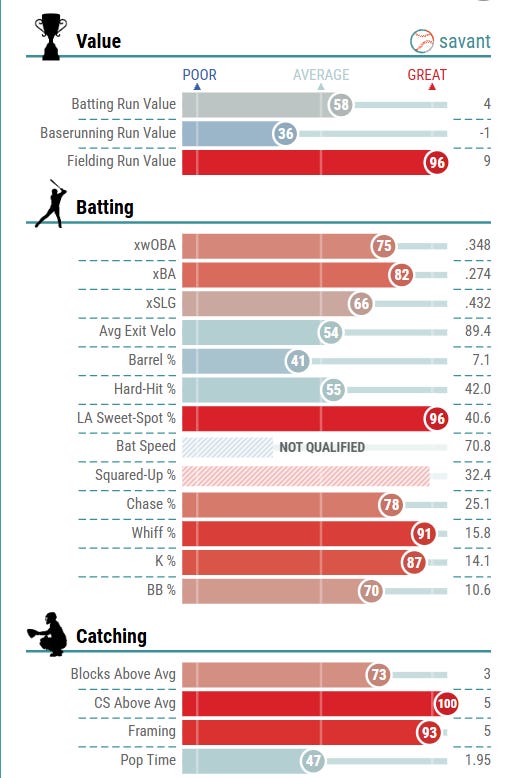
When you look at Rutschman’s Baseball Savant page, there is plenty to be excited about. The underlying metrics suggest there is still an All-Star caliber player in there, and there is every reason to believe he can return to that level if he stays healthy.
Erik Miller
Adding Erik Miller to a bullpen that already owns the best ERA in baseball is an absolute luxury for Chad Tracy late in games. Over the past six weeks, the quartet of Aroldis Chapman, Garrett Whitlock, Justin Slaten, and Tayler Guerrero has been outstanding. If there was one thing this bullpen lacked, it was another power left-handed arm. Miller checks that box.
A big, hard-throwing left-hander with excellent extension, Miller fits the exact mold of pitcher the Red Sox have targeted in recent years.
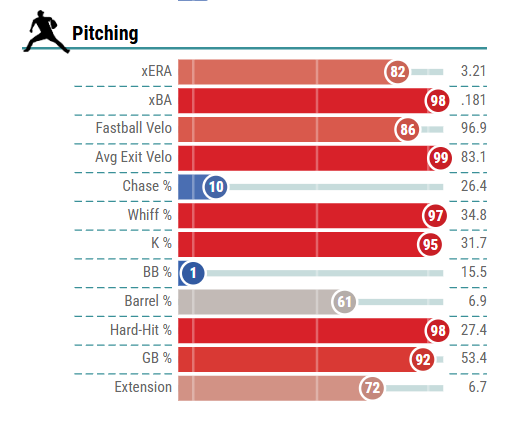
He has been outstanding out of the Giants’ bullpen this season and gives Boston another high-leverage weapon for the stretch run.
38 G: 2.78 ERA, 3.34 FIP, 12.4 K/9
Adding another high-leverage reliever should also help ease the workload on pitchers like Garrett Whitlock and Tayler Guerrero. Just as importantly, having a power left-hander other than Aroldis Chapman to match up against the opposition’s best left-handed hitters gives the Red Sox another valuable weapon over the final two months of the season. Chad Tracy now has the ability to shorten games, and on some nights, he may only need four or five innings from his starting pitcher.
The second way to evaluate these trades is by looking at their long-term ramifications. While the steep price for Rutschman significantly reduced the organization’s pitching depth, I trust Craig Breslow to replenish it. Since taking over, Breslow has consistently shown an ability to identify pitchers who fit the Red Sox’s development model, whether through the draft, trades, or free agency. His track record suggests Boston will continue to find and develop quality arms.
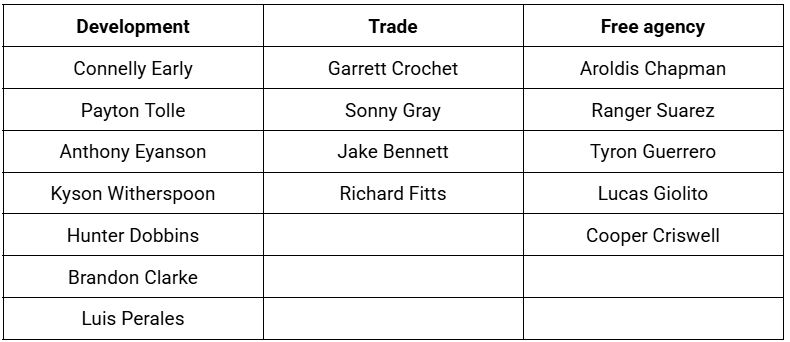
Every player in the chart above has either made a meaningful contribution to the Red Sox or been used as a trade chip to improve the major league roster during Craig Breslow’s tenure. Because of that track record, I have confidence that Breslow and pitching coach Andrew Bailey will continue to identify and develop quality pitching talent more often than not.
The part of this deadline that I continue to wrestle with is the decision to trade Marcelo Mayer. Mayer entered professional baseball as one of the most highly regarded prospects in the sport. Widely viewed as the top talent in the 2021 MLB Draft, he spent most of his minor league career ranked among baseball’s top 20 prospects. Yet after just 114 major league games and 364 at-bats, Breslow and the front office decided they had seen enough to move on. Some prospects force organizations to make quick decisions, but with a player as talented as Mayer, more time may have been exactly what he needed to reach his ceiling.
Reports during the offseason suggested that Mayer and Connelly Early could have been the centerpiece of a deal for Ketel Marte, who was coming off back-to-back top-three finishes in the National League MVP voting while playing on one of baseball’s most team-friendly contracts. I don’t fault the Red Sox for holding onto Mayer then, but it does make this trade feel like a dramatic shift in philosophy just eight months later.
To be fair, Mayer still has plenty to prove. Above all else, he needs to show he can stay healthy, something he has struggled to do throughout his professional career. There are also legitimate concerns about both his swing mechanics and swing decisions. At the same time, Mayer is still only 23 years old, and he reached the major leagues before his development was complete. Injuries robbed him of valuable minor league repetitions, and it’s entirely possible that he simply needed more time. Unfortunately for both Mayer and the Red Sox, time was something Boston no longer felt it could afford.
It’s also possible that Mayer was never destined to reach his full potential in Boston. Some have argued that, as a West Coast kid, he wasn’t the ideal fit for the expectations and pressure that come with playing in this market. While there may be some truth to that, I generally believe talent wins out over pressure. That said, there are plenty of examples of gifted players who never found their footing in big markets. Maybe Boston simply wasn’t the right fit for Mayer.
Even so, that’s what makes this trade difficult for me to evaluate. I think Erik Miller is an outstanding addition who could play an important role in a postseason run. But it’s hard not to view it as a disappointment that the organization ultimately traded Marcelo Mayer for a reliever.
Not long ago, the Red Sox had what many considered the best young core in baseball. Roman Anthony, Kyle Teel, and Marcelo Mayer formed the “Big Three,” and Kristian Campbell’s emergence turned that into a “Big Four.” Red Sox fans, myself included, envisioned that group becoming the foundation of the organization’s next championship contender. Today, Teel is in Chicago, Mayer is in San Francisco, Campbell has bounced between Boston and Worcester, and Anthony is the only one still in the organization. Even he has struggled to make a consistent impact because of injuries.
Building from within has always been an appealing blueprint, but there has never been a guarantee that elite prospects translate into championships. The Red Sox are simply the latest reminder of that reality. While Craig Breslow initially committed to building around the organization’s young talent, he also deserves credit for recognizing when it was time to pivot. I can’t say the Red Sox were clear winners at this year’s trade deadline, but I understand the vision behind the moves. They have improved the current roster and given themselves a legitimate chance to make a deep postseason run.
At the same time, there is a very real possibility that some of the prospects Boston traded away become stars elsewhere. If that happens, these deals will be debated for years to come. That’s the nature of a bold trade deadline—and only time will determine whether Craig Breslow made the right bets.